In 2022, Dunzo underwent rapid scaling. A surge in dark stores brought a pressing need for critical inventory management features. As the product grew, so did the complexity of managing it. I worked on enhancing the experience for both the consumer and merchant apps, spanning feature design, catalog management tooling, and the foundations of a design system.
Dunzo was scaling faster than its tooling could keep up with. On the consumer side, product discovery was suffering — users were not finding what they needed, and the homepage was not doing enough to surface it. On the merchant side, the team was relying on third-party tools to manage inventory despite a proprietary system being in production for over a year.
Critical features were missing, workflows were inefficient, and without a design system, every new feature introduced more inconsistency. The challenge was to close the gaps in the merchant tooling, improve discovery for consumers, and build a foundation that would let the product scale without fragmenting.
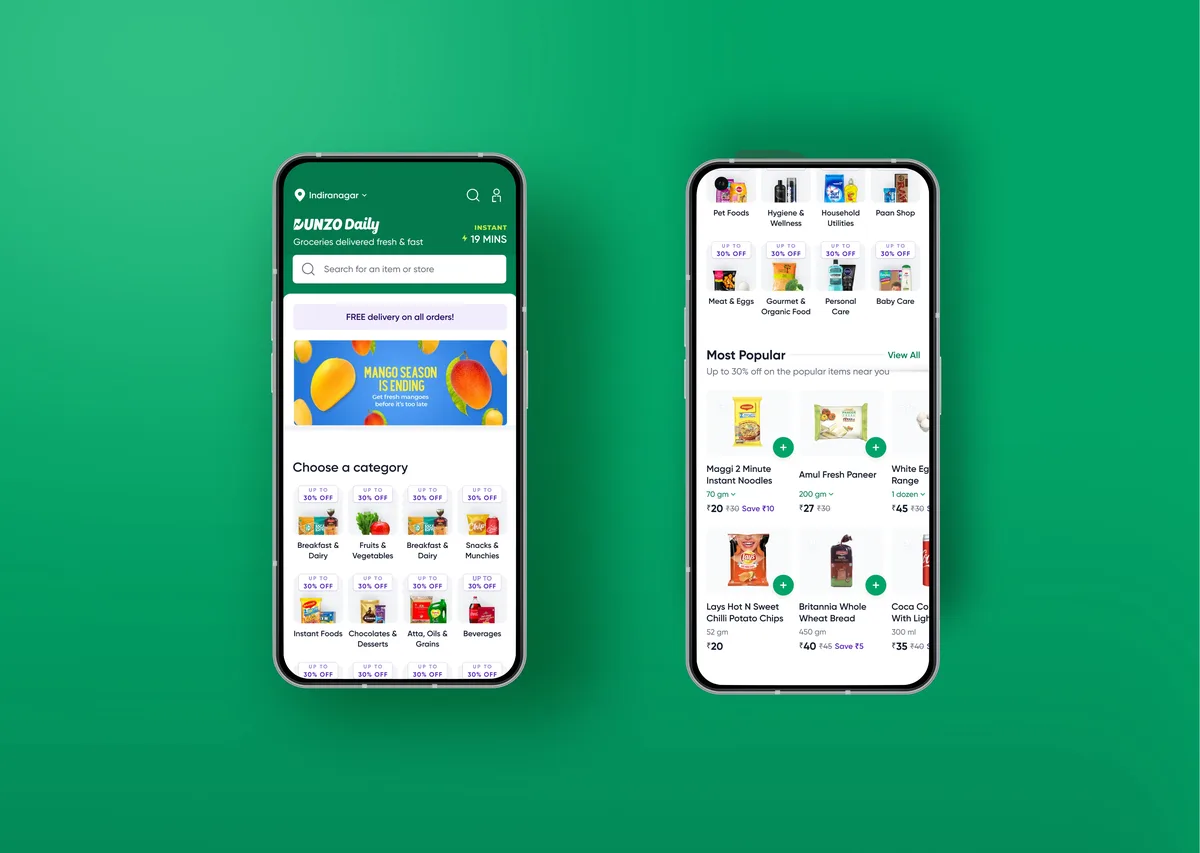
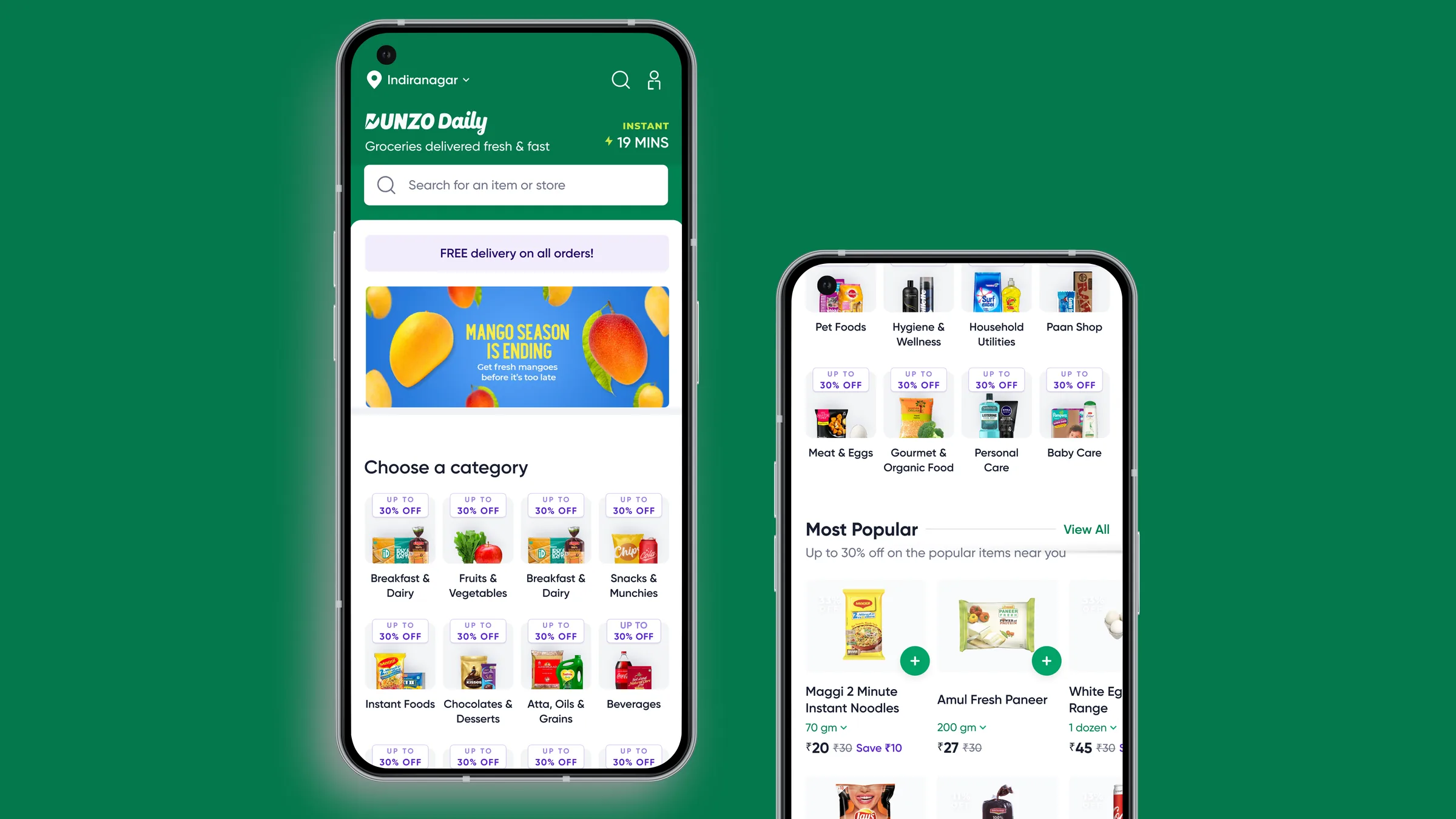
70% of product discovery on Dunzo happened through the homepage catalog, making it one of the most critical surfaces in the app. Yet the existing layout was working against itself: high-contrast offer banners dominated the screen, causing banner blindness, while large card sizes meant fewer products were visible at a glance, creating the false impression of limited availability.
I redesigned the grid to show more products by reducing card size and expanding the overall grid. Each category was represented by two curated products to give users a clearer sense of what it contained. I also reduced the saturation of the offers banner to let it inform without overwhelming. The feature went live to 100% of users and significantly improved conversions from the homepage.
The merchant team had been managing inventory through third-party workarounds despite having a proprietary system in place. Working alongside product managers and business stakeholders, I identified the key capabilities the tool was missing and designed features to close those gaps.
I introduced the ability to add new products directly to the inventory, removing dependence on external tools. I built a task management interface for catalog managers to track and action inventory updates, streamlining a process that had previously been fragmented across tools. I also added campaign tagging functionality, allowing catalog managers to flag products eligible for discounts during promotional periods.
Together, these features significantly reduced the inventory workload for the merchant team and made the proprietary system viable as a standalone tool.
As Dunzo scaled, the absence of a design system was beginning to show. A thorough audit of the app revealed inconsistencies across screens — in typography, spacing, component behaviour, and visual language. Left unaddressed, this would only compound as the team shipped more features.
I led the creation of a component library as the first step toward a shared design system. The library gave the design team a consistent set of building blocks to work from, and provided a common language to collaborate more effectively with engineering. New features could be designed and built faster, with greater consistency and less rework.
The redesigned catalog shipped to 100% of users and lifted conversions on the homepage, the surface that drives 70% of all product discovery on Dunzo.
The new inventory tooling cut the merchant team's workload and finally made the proprietary system viable on its own, ending the reliance on third-party workarounds.
The first component library gave design and engineering a shared language, so new features shipped faster and with far less rework as the product kept scaling.